
Day Boarding School vs Residential School: Understanding the Key
20 Nov 2026
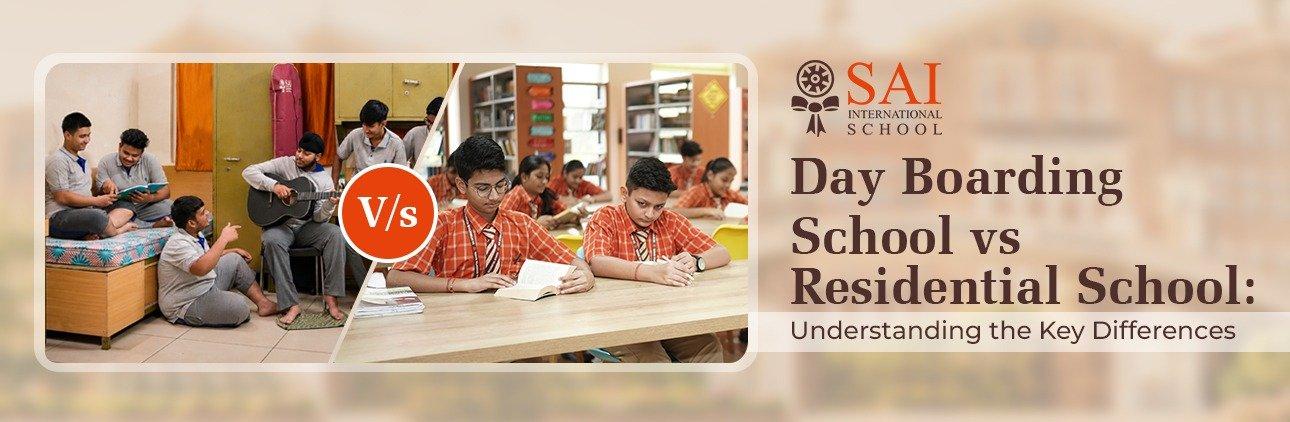
Picking a school is hard enough. Choosing between a day boarding school and a residential school further adds to this difficulty because the decision affects where your child sleeps, how often you see them and how much of their growing up happens at home. Both models offer longer hours and more structure than a regular day school but they both differ in how far that structure reaches into a child's life.
Hence, this blog explains how each option works, where they differ and which families tend to choose which.
In a day boarding school vs residential school comparison, the main difference is where the child spends the night. Day boarders stay at school for most of the day, including meals, activities and supervised study and return home in the evening. Residential students live on campus throughout the term.
What Is a Day Boarding School?
A day boarding school keeps students on campus for a much longer day than a regular school does. Classes usually end around the same time as in a day school but children stay on for lunch, sports, clubs and a supervised study period. They go home in the evening. Teachers are often available to help with homework so most schoolwork is finished before the child reaches home.
What Is a Residential School?
A residential school, also called a boarding school, is one where students live on campus during the term. The hostel is part of the school. Wardens look after the children, meals are served in a common dining hall and the day follows fixed timings for waking up, studying and lights out. Students go home for vacations and meet their families on permitted visiting days. Since the school handles nearly every hour of the day, it shapes a child's habits far more than a day school can.
Key Differences Between a Day Boarding School & a Residential School
| Aspect | Day Boarding School | Residential School |
| Living arrangement | Day boarders attend school during the day and return home in the evening. | Residential students live in the school hostel. |
| Family time | Day boarders spend time with their parents every evening. | Residential students meet family during breaks and visiting days and usually speak by phone at set times. |
| Daily structure | Students follow a fixed timetable during school hours. | Students follow a structured timetable that also covers mornings, evenings, nights, and weekends. |
| Independence | Day boarding helps students develop independence gradually while remaining close to their families. | Residential schooling requires students to develop a greater degree of independence from an early stage. |
| Cost | Day boarding is generally less expensive than residential schooling. | Residential schooling generally costs more as the fees include accommodation, meals, and round-the-clock supervision. |
| Age fit | Day boarding is suitable for students of most age groups, including younger children. | Residential schooling is often a better fit from the middle school years when children can manage time away from home. |
Benefits of Day Boarding School
For many families, day boarding feels like the balanced option. A child gets a full, active school day without leaving home and parents keep their evening routine. Here are a few advantages that stand out:
- Parents stay close to everyday life. They are there for dinner, for bedtime and for the small conversations that rarely happen over a phone call.
- Homework pressure also drops. When study time happens at school with a teacher nearby, evenings at home are calmer and a little more free.
- Children get more than academics too. Sports, music, drama and clubs fit naturally into a longer day.
- Finally, the change is gentler for younger children, who still sleep in familiar surroundings every night.
When a Residential School Makes Sense
A residential school suits a different set of circumstances. Some families live far from a good school or a parent's job involves frequent transfers or travel. In other cases, the child is simply ready for it and wants the experience. Living with classmates teaches practical habits such as managing time, looking after belongings and sorting out small disagreements without a parent stepping in.
It does come with challenges. Homesickness is common in the first few weeks and it usually eases as the child settles into the routine. Parents also need to be comfortable with seeing their child less often. A child who is pushed into boarding against their wishes tends to struggle more than one who has had a say in the decision.
How to Choose Between the Two
A day boarding school vs residential school decision is rarely about which one is better in general. It is about which one fits your child and your situation. A few questions usually settle it such as:
- How old is your child and how do they cope with time away from you?
- How far is the school from home?
- How involved do you want to be in the daily routine?
- And what does the family budget allow?
If the answers point toward staying close to home, a day boarding school in Odisha is likely the better fit. If distance, career demands or the child's own wish point the other way, a residential school deserves a serious look.
Whichever way you lean, visit the campus and ask how supervision, meals and study time actually work.
Conclusion
As we said, both day boarding and residential schools have their own place. Day boarding keeps the family at the centre while giving the child a long, structured school day. Residential schooling offers deeper immersion and independence, at the cost of time at home. Neither is right for every child and the best choice is the one that matches the child's age, personality and the family;s circumstances.
At SAI International School, we run a day-boarding model on our Chandrasekharpur campus in Bhubaneswar, with CBSE and Cambridge curricula to choose from. Students have access to sports facilities across a campus of over 335K sq. ft. and to a wide range of clubs and societies. Teachers are available in the evenings to clear academic doubts.
Families who prefer a fully residential setting can also look at SAI International Residential School, our campus for Grades IV to XII. We would be happy to show you around so you can see how each option works in person.
Photo Highlights